Overview
A pilot initiative utilizing artificial intelligence and satellite monitoring to assess mangrove forest health, aimed at restoring over 500 rai (200 acres) of Andaman coastal areas with a target carbon sequestration of more than 15,000 tons annually.
What is this activity ?
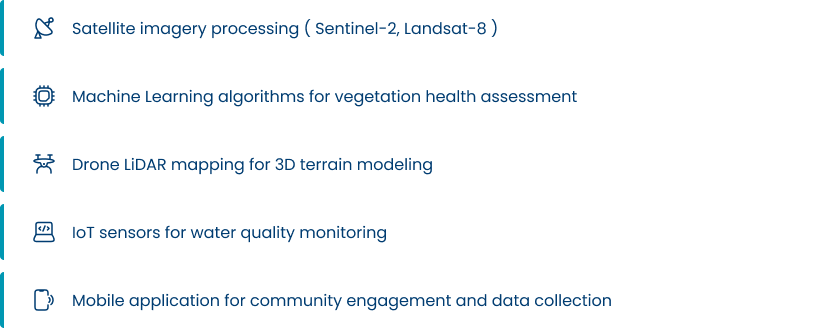
The Mangrove Restoration Project is a collaborative initiative between government agencies, private sector, and local communities, utilizing AI and Remote Sensing technologies for real-time monitoring and assessment of mangrove forest health. The system analyzes data from Sentinel-2 and Landsat-8 satellites to monitor vegetation density, coastline changes, and sea levels. Additionally, drone mapping is employed to create high-resolution 3D maps of mangrove areas.
Why are we doing this ?
- Restore Coastal Ecosystems Create suitable habitats for over 250 species of aquatic and wildlife
- Prevent Coastal Erosion Mangroves reduce wave energy and prevent soil degradation
- Increase Community Income Generate supplementary income through eco-tourism and sustainable aquaculture
- Carbon Sequestration Mangroves can capture 4-5 times more carbon than tropical rainforests
How does it help the planet ?
- Fighting Climate Change Captures more than 15,000 tons of CO₂ from the atmosphere annually, equivalent to removing over 3,200 cars from the road
- Biodiversity Serves as a breeding ground for economically important aquatic species and rare migratory birds
- Food Security Increases coastal fishery yields for local communities
- Scalable Model The developed technology can be applied to other areas in Southeast Asia
Project Duration
January 2024 – December 2026 (3 years)
Location
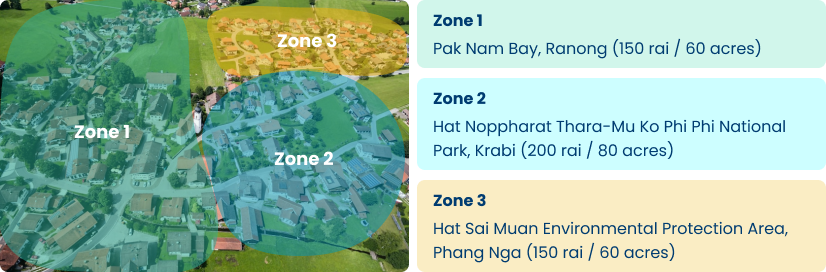
Andaman Sea coastal areas in Ranong, Phang Nga, and Krabi provinces, Thailand
Partners and Credits
- Lead Organization GreenTech Solutions Thailand Co., Ltd.
- Partners
- Department of Marine and Coastal Resources ( DMCR )
- Kasetsart University, Faculty of Fisheries
- International Union for Conservation of Nature (IUCN)
- Microsoft AI for Earth Program
- Financial Supporters Global Environment Facility (GEF), Carbon Credit Initiative Thailand
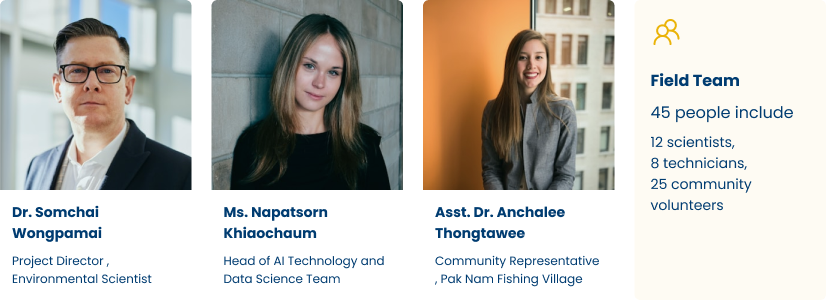
Key Participants
International Advisory Board

Expected Outcomes
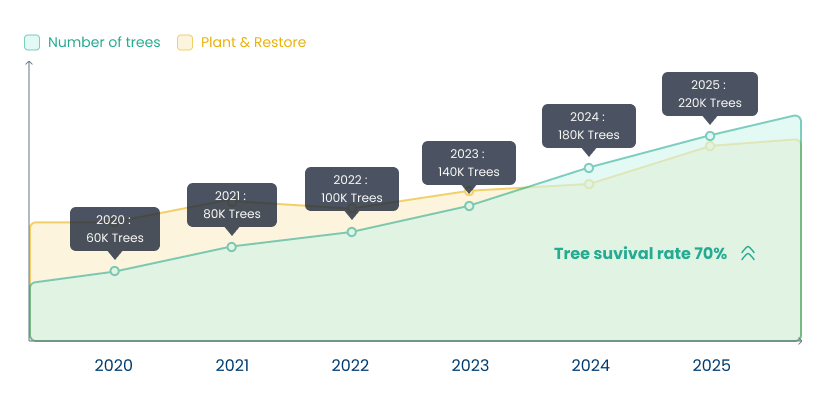
- Plant and restore more than 250,000 mangrove trees
- Tree survival rate of at least 85%
- Create a digital database for real-time mangrove health monitoring
- Transfer knowledge to at least 500 local households
- Produce manuals and best practices for similar projects
Community Impact
- Increase average fishing household income by 30-40% through eco-tourism and increased fishery yields
- Create 120 new jobs for community members (35 permanent positions)
- Develop technological skills for 200 local youth
Technologies Used
Community Impact
- Verified Carbon Standard ( VCS )
- Climate, Community & Biodiversity Standards ( CCB )
- UN Sustainable Development Goals alignment ( SDG 13, 14, 15 )
Refer
https://docs.google.com/document/d/1q3qhyFErsJkcdDQNkOnus19j1BUhEZg8kojbyBfeRG0/edit?usp=sharing